


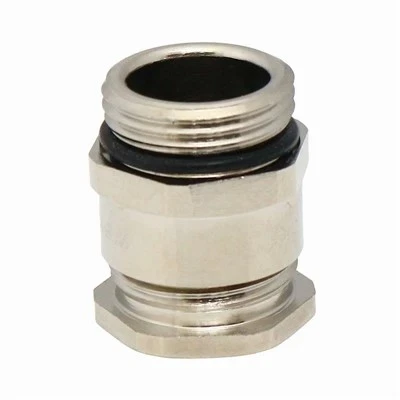
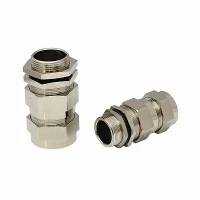
Earthing Gland Locknut
The Earthing Gland Locknut (also known as an EMC grounding locknut or star locknut) secures cable glands into electrical enclosures while establishing a secure mechanical and electrical bond. Integrated piercing teeth bite through panel paint, anodizing, or surface contamination to make direct contact with bare metal. This eliminates the need for external grounding straps, reduces installation time, and provides low-impedance earth continuity for effective EMC/EMI shielding.
EMC Brass & Stainless Steel Earthing Gland Locknut
The Earthing Gland Locknut (also known as an EMC grounding locknut or star locknut) secures cable glands into electrical enclosures while establishing a secure mechanical and electrical bond. Integrated piercing teeth bite through panel paint, anodizing, or surface contamination to make direct contact with bare metal. This eliminates the need for external grounding straps, reduces installation time, and provides low-impedance earth continuity for effective EMC/EMI shielding.
Key Features
Material Composition: Precision-machined or stamped from high-grade brass with bright nickel plating, or optional 304/316 stainless steel for enhanced corrosion resistance.
Biting Tooth Structure: Integrated sharp serrations or claw teeth penetrate non-conductive surface layers (paint, powder coating) upon tightening.
Clamping Mechanism: Flat bearing face ensures uniform torque distribution against enclosure walls without slipping or thread distortion.
EMC Performance: Designed to maintain continuous ground paths, suppressing electromagnetic interference (EMI) and radio frequency interference (RFI) at cable entry points.
Technical Specifications
|
Specification |
Details |
|
Thread Types |
Metric (ISO), PG (DIN 40430), NPT (ANSI B1.20.1), G (BSPP) |
|
Thread Sizes |
Metric M12 to M63; PG7 to PG48; NPT 1/4" to 2" |
|
Material Options |
Nickel-plated brass (standard), Stainless Steel (AISI 304 / 316) |
|
Operating Temperature |
-40°C to +100°C (Brass); up to +250°C (Stainless Steel with metal seals) |
|
Ingress Protection |
Maintains panel IP rating (IP66 / IP68 / IP69K) when combined with standard cable glands and sealing washers |
Product Options
Plating Options: Standard nickel plating; unplated brass; passivated stainless steel.
Tooth Configurations: Single-sided claw teeth vs. dual-sided serrations for specialized enclosures.
Custom Thread Tolerances: Special pitch or modified thread lengths for thick-wall enclosures.
Applications
Industrial Control Panels: Automation cabinets requiring EMC shielding and ground continuity.
Switchgear & Distribution Boards: Low and medium-voltage electrical distribution panels.
Outdoor & Marine Equipment: Weatherproof junction boxes exposed to vibration and moisture.
Renewable Energy Systems: Inverters, solar combiner boxes, and wind turbine control housings.
OEM & ODM Customization
In-House Capabilities: CNC machining and high-speed precision stamping lines.
Custom Development: Tailored thread dimensions, non-standard wall thicknesses, and special claw geometries based on 2D/3D CAD drawings.
Material Traceability: Mill test certificates available for specific brass alloys (e.g., CuZn39Pb3) and stainless steel grades.
Packaging Solutions: Bulk industrial packaging, customized retail bagging, and barcoded labeling for distributors.
Quality Control & Engineering Support
Dimensional Inspection: Optical comparators and digital thread gauges verify major diameter, pitch diameter, and thread tolerance class (6H).
Plating Thickness Test: X-ray fluorescence (XRF) coating thickness analysis ensures uniform nickel layer coverage (min. 3–5 µm).
Torque & Clamping Verification: Routine destruction and torque testing to verify structural integrity under high fastening loads.
Documentation Support: Material Test Reports (MTR / EN 10204 3.1), RoHS compliance declarations, and REACH certificates provided upon request.
CAD Resource Integration: 2D and 3D CAD files (STEP format) available for engineering design and panel layout integration.
Frequently Asked Questions
Q: How do earthing locknuts penetrate painted panels?
A: The locknut features hardened, sharp piercing teeth on the underside. As torque is applied, these teeth cut through paint or powder coating to establish direct metal-to-metal contact with the enclosure wall.
Q: Are these locknuts compatible with standard metric cable glands?
A: Yes. All metric earthing locknuts adhere strictly to standard ISO thread dimensions and interchange directly with standard cable glands.
Q: What is the difference between brass and stainless steel versions?
A: Nickel-plated brass is ideal for standard industrial environments offering balanced conductivity and corrosion resistance. Stainless steel (304/316) is selected for marine, chemical, or food-processing environments requiring superior chemical resistance.
Q: Do I need external grounding wires if I use this locknut?
A: In many EMC-critical applications, the earthing locknut provides sufficient high-frequency ground continuity for the braided cable shield through the enclosure wall, though local electrical codes should always be verified.
Q: What is the minimum order quantity (MOQ) for standard sizes?
A: Standard sizes (M16–M32 in nickel-plated brass) are stocked in regular production batches with flexible MOQ terms for distributors and OEM clients.
Q: What is the typical production lead time?
A: Standard stock items ship within 3–5 business days. Custom manufactured specifications typically require 15–25 business days depending on volume and plating requirements.
Request a Quote
To receive a prompt technical proposal, CAD files, and commercial quotation, please provide the following details:
Product & Specification: (e.g., EMC Earthing Locknut, Metric Thread)
Thread Size & Type: (e.g., M20 x 1.5)
Material: (Nickel-plated brass / Stainless Steel 304 / 316)
Quantity Required: (Annual volume or trial order quantity)
Special Requirements: (Custom thread length, specific packaging, or compliance certificates)
Hot Tags: earthing gland locknut, China earthing gland locknut suppliers, factory


Send Inquiry
